Search within Results Search Headings


1 2 3 4 5 6 7
Population // Urban Living //

Ice House


ICE HOUSE, or ICE PALACE, was constructed in December 1739 - January 1740 (architect P.M. Eropkin, engineer G.V. Kraft) by the order of Empress Anna Ioannovna at the bank of the Neva, near the Winter Palace, to celebrate the mock wedding of prince M.A. Golitsyn and A.I. Buzheninova. It was made of ice blocks joined with water and designed a la Baroque (the house was 17.1 meters long, 5.3 meters wide and 6.4 meters high).
Architecture // Architectural Monuments // Public Buildings and Edifices //
Sports // Sports and Recreation Facilities //

Ice Palace


ICE PALACE (1 Pyatiletok Avenue). A sports structure opened on 18 October 2000. Built according to the plans by the Moscow Scientific Research Institute for Objects of Culture, Recreation, Sport, and Health, and by the Eagle Group International Company (Finland) (architects A.V. Bokov, S. Kilpiya, H. Laitila, S.I. Sokolov, H. Tinkanen). It seats over 12,000 spectators.
City Administration // Personalia //

Ignatiev P.N. governor-general in 1854-61


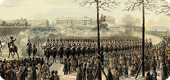
IGNATIEV Pavel Nikolaevich (1797-1879, St. Petersburg), count (1877), statesman, infantry general (1859), adjutant-general (1846), honorary member of St. Petersburg Academy of Sciences (1856). After graduating from Moscow university (1814) he served in the Guards; on the day of Decembrists riot (December 14, 1825) he guarded Winter Palace with the company of Preobrazhensky regiment, owing to which he was awarded by the rank of aide-de-camp.
Religion. Church // Personalia //

Ignaty (Bryanchaninov) (1807-1867), Orthodox Saint


IGNATY (born Dmitry Alexandrovich Bryanchaninov) (1807-1867), religious figure, theologian and spiritual writer. In 1822-26, he studied at the Central Engineering College of St. Petersburg, during this time he often visited the house A.N. Olenin, where he met Alexander Pushkin, I.A. Krylov, N.I. Gnedich and other men of letters who highly praised his attempts at writing.
Religion. Church // Personalia //

Ignaty (Malyshev) (1811-1897), Archimandrite


IGNATY (born Ivan Vasilievich Malyshev) (1811-1897, Holy Trinity and St. Sergius Hermitage), Archimandrite. In 1823, Ignaty was brought to St. Petersburg where he worked as an errand-boy, then as a salesclerk. In 1836, he became a lay-brother of Archimandrite Ignaty (Bryanchaninov) at the Holy Trinity and St. Sergius Hermitage. In 1842, he took monastic vows under the name of Ignaty.
City Administration // Personalia //

Ignatiev P.N. governor-general in 1854-61


IGNATIEV Pavel Nikolaevich (1797-1879, St. Petersburg), count (1877), statesman, infantry general (1859), adjutant-general (1846), honorary member of St. Petersburg Academy of Sciences (1856). After graduating from Moscow university (1814) he served in the Guards; on the day of Decembrists riot (December 14, 1825) he guarded Winter Palace with the company of Preobrazhensky regiment, owing to which he was awarded by the rank of aide-de-camp.
Religion. Church // Personalia //

Ignaty (Bryanchaninov) (1807-1867), Orthodox Saint


IGNATY (born Dmitry Alexandrovich Bryanchaninov) (1807-1867), religious figure, theologian and spiritual writer. In 1822-26, he studied at the Central Engineering College of St. Petersburg, during this time he often visited the house A.N. Olenin, where he met Alexander Pushkin, I.A. Krylov, N.I. Gnedich and other men of letters who highly praised his attempts at writing.
Religion. Church // Personalia //

Ignaty (Malyshev) (1811-1897), Archimandrite


IGNATY (born Ivan Vasilievich Malyshev) (1811-1897, Holy Trinity and St. Sergius Hermitage), Archimandrite. In 1823, Ignaty was brought to St. Petersburg where he worked as an errand-boy, then as a salesclerk. In 1836, he became a lay-brother of Archimandrite Ignaty (Bryanchaninov) at the Holy Trinity and St. Sergius Hermitage. In 1842, he took monastic vows under the name of Ignaty.
Social Life // Political Parties and Organizations //

Illegal Printing Offices


ILLEGAL PRINTING OFFICES opened in St. Petersburg by revolutionary organizations to print illegal press such as periodicals, brochures, and leaflets. A printing office would be organized in a rented apartment, equipment and fonts usually delivered illegally from abroad or made by revolutionaries themselves, and generally operate for a few months. The first illegal printing offices appeared in the early 1860s including P.D. Balloda's Pocket Press opened in 1862.
Architecture // Personalia //

Ilyin L.A. (1880-1942), architect.


ILYIN Lev Alexandrovich (1880-1942), architect, Fellow of the Academy of architecture of the USSR (as of 1941). He studied at the College of Civil Engineers (1897-1909) and at the Academy of Fine Arts (1903-04). He was a member of the Old St. Petersburg Society, one of the main initiators of the creation of the City Museum (1918-35) and its first director. In 1925-38, he was the acting chief architect of Leningrad (nominally, this position appeared in 1938).
Architecture // Bridges //

Ilyinsky Bolshoy Bridge


ILIINSKY BOLSHOY BRIDGE (Ilyinsky, Okhtinsky No.3), across the Okhta River, along Revolution Highway. Named after the Church of St. Elijah the Prophet. Constructed in 1912, it replaced a wooden bridge. The aperture is covered with three-span continuous beam, by the Zhelezo-Beton Company; engineer G.A. Hirschson. It is the first reinforced concrete bridge in St. Petersburg.
Capital // Imperial Court //
Architecture // Cemeteries (see also Municipal Economy) //

Imperial Burial Vault


IMPERIAL BURIAL VAULT. A final burial place for members of the Imperial Family had not yet been ultimately determined during Peter the Great's reign. The Tsars' kin were most often buried at the Holy Annunciation Church Burial Vault.
Capital // Imperial Court //

Imperial Court


IMPERIAL COURT, Russian Emperors' court personnel, organized by Emperor Peter the Great according to French and Prussian courts, finally brought under strict regulations during Emperor Nikolas I's reign. The Imperial Court consisted of people having special court ranks divided into 1st and 2nd court, court cavaliers (Gentlemen-in-Waiting, Gentleman of the Monarch's Bedchamber), and ladies (Maids of honour).
Capital // Imperial Court //

Imperial Entrances


IMPERIAL ENTRANCES, court ceremonies in the 18th - the early 20th centuries.
Capital // Imperial Court //

Imperial Family


IMPERIAL FAMILY, members of the Russian monarch's family, called by succession to the throne or by lawful marriage to those who had such right. Legal status of the Imperial Family was ratified by Emperor Pavel I in 1797 by the Resolution on the Imperial Family, which was changed in 1886 under Emperor Alexander III. Members of the Imperial Family had the right of title, annual income from appendages, a personal court, a coat of arms, and other privileges.
1 2 3 4 5 6 7
Rambler's Top100