The subject index
/
Bolshoy Gostiny Dvor
hidden
|
Brokgauz-Efron, publishing house, 1889-1930
BROKGAUZ-EFRON, a publishing house established in 1889 on the initiative of S.A. Vengerov by a St. Petersburg printer I.A. Efron and Leipzig Publishing Company of F.A. Brokgauz
|
|
|
|
|
hidden
|
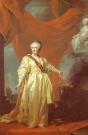
Catherine II (1729-1796), Empress
Catherine II (1729-1796, St. Petersburg), Empress (from 1761), wife of Emperor Peter III (1745). Nee Sophie Augusta Frederica of Anhalt-Zerbst. Lived in St. Petersburg from 1744, coming to power by dethroning her husband (1762)
|
|
|
|
|
hidden
|
Commerce (general)
COMMERCE. Favorably located, St. Petersburg has always played a major role in the country’s foreign trade (see Sea Port). The life of the city itself has been mainly supported by home trade, retail trade above all
|
|
|
|
|
hidden
|
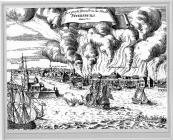
Fires (entry)
FIRES. Especially common in the first years of St. Petersburg's existence. The first large fire happened in 1710 on Troitskaya Square. A prohibition against constructing wooden houses within city limits was issued in 1727
|
|
|
|
|
hidden
|
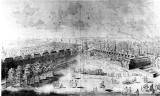
Gostiny Dvor
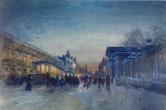
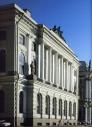
GOSTINY DVOR (Trading Court), a trading center made up of rows of shops. The first city market of this kind consisting of numerous wooden shops appeared in Berezovy (Gorodskoy) Island near the present-day Troitskaya Square
|
|
|
|
|
hidden
|
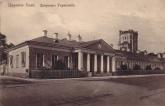
Hastie V.I. (1753-1832), architect.
Hastie Vasily Ivanovich (William) (1753-1832), architect. Native of Switzerland, in 1784 he came to Russia by invitation of C. Cameron, settling in Tsarskoye Selo on Angliiskaya Street
|
|
|
|
|
hidden
|
Konovnitsyn P.P., Civilian Governor
KONOVNITSYN Peter Petrovich (1743 or 1744-1796), statesman, Lieutenant General (1786). He graduated from the Naval Gentry Cadets' College in St. Petersburg (1762)
|
|
|
|
|
hidden
|
Kukhmisterskayas (cook-shops)
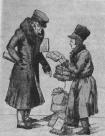
KUKHMISTERSKAYAS (from the German Kuchenmeister, or cook). Cafeterias or cheap restaurants, established to "meet the needs of low class clerks and other poor men", as well as to provincials arriving to St. Petersburg
|
|
|
|
|
hidden
|
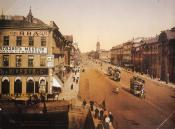
Nevsky Prospect
NEVSKY PROSPECT known as Bolshaya Pershpektivnaya Road or Bolshaya Pershpektiva until 1738, Nevskaya Prospektivaya Street or Nevskaya Perspektiva in 1738-1780s, and 25 October Avenue in 1918-44 so named in memory of the October Revolution of 1917
|
|
|
|
|
hidden
|
Panoramas (entry)
PANORAMAS, 1) A genre of fine art. The first panoramic view of St. Petersburg was created by artist A. F. Zubov in 1716. The most famous panoramas include: The Splendid Avenues by artist M. I. Makhaev (1753), Panorama of St. Petersburg by J. A
|
|
|
|
|
hidden
|
Perinnaya Line
PERINNAYA LINE lying along Bolshoy Gostiny Dvor between Nevsky Prospect and Lomonosova Street. In the mid-to-late 19th century, it was known as Surovskaya, or Bolshaya Surovskaya, Line (Textile Line) so named because of the goods sold in the line
|
|
|
|
|
hidden
|
Public Lavatory
PUBLIC LAVATORY. Since the early 18th century, primitive latrines were arranged on the territory of gostiny dvors, markets, ports, and along river and canal banks
|
|
|
|
|
hidden
|
Rainbow Publishing House, 1922-1930
RAINBOW Publishing House was founded in 1922. Journalist L. M. Klyachko was its creator and owner. The main office was situated in the Bolshoy Gostiny Dvor, the editorial board was housed in the flat of Klyachko (14 Stremyannaya Street)
|
|
|
|
|
hidden
|
Rinaldi А. (1709-1794), architect
RINALDI Antonio (around 1709-1794), architect of Italian descent. Studied in Naples under L. Vanvitelli. From 1752 served under Hetman K.G. Razumovsky in Malorussia (Little Russia, otherwise known as Ukraine). Since 1754 resided in St
|
|
|
|
|
hidden
|
Sadovaya Street
SADOVAYA STREET (from 1923 to 1944 - Third of July Street, the section from Italyanskaya Street up to Ekaterininsky Canal; from the 1730s to 1887, it was known as Bolshaya Sadovaya Street; the part from Moika River Embankment to Italyanskaya Street
|
|
|
|
|
hidden
|
Second-Hand Book Trade (entry)
SECOND-HAND BOOK TRADE or bouquiniste trade (from the French word bouquin - an old book). From the time of the opening of the book trade in St. Petersburg at the beginning of the 18th century
|
|
|
|
|
hidden
|
Serafim Vyritsky (1866-1949), venerable
SERAFIM VYRITSKY (lay name Vasily Nikolaevich Muravyev) (1866-1949), a saint of the Russian Orthodox Church. In boyhood he moved to St. Petersburg where he worked in the Gostiny Dvor (merchant's court)
|
|
|
|
|
hidden
|
Taxi
TAXI (borrowed into Russian from the word derived from English tax), motor vehicles transporting passengers for a fee. Private taxicabs appeared in St. Petersburg in the autumn of 1908, at the same time carrier joint-stock companies sprang up
|
|
|
|
|
hidden
|
Tsentralny (Central) District
TSENTRALNY (CENTRAL) DISTRICT, an administrative-territorial entity within St. Petersburg, with the territorial administration situated at 176 Nevsky Prospect. The district was set up in 1994, when Smolninsky District
|
|
|
|
|
hidden
|
Vallin de la Mothe J.-B.M. (1729-1800), architect.
VALLIN DE LA MOTHE Jean Baptiste Michel (1729-1800), French architect. Is thought to have studied under the supervision of his cousin, architect J.F. Blondel. In 1750-52, he further perfected his skills in Italy
|
|
|
|
|
hidden
|
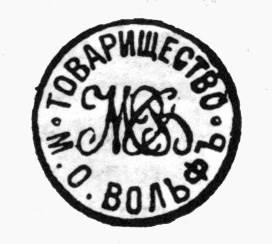
Wolf M.O. (1825-1883), publisher
WOLF Mavriky Osipovich (Boleslav Maurytzy) (1825-1883, St. Petersburg), publisher and book-seller. He graduated from a gymnasium in Warsaw in 1838. He lived in St. Petersburg from 1848. Wolf set up his own company under the label M.O
|
|
|
|
|
|
hidden
|