The subject index
/
Synod
hidden
|
Amvrosy (Podobedov) (1742-1818), Metropolitan of Novgorod and St. Petersburg in 1799-1818
AMVROSY (born Andrey Ivanovich Podobedov) (1742-1818), religious figure. In 1757-64 he studied at the Seminary of the Holy Trinity Lavra of St. Sergius, and later spent several years teaching there
|
|
|
|
|
hidden
|
Anthony (Vadkovsky) (1846-1912), Metropolitan of St. Petersburg and Ladoga 1898-1912
ANTHONY (lay name Alexander Vasilievich Vadkovsky) (1846-1912, St. Petersburg ), Church figure, honorary member of the St. Petersburg Academy of Sciences (1899)
|
|
|
|
|
hidden
|
Biblical Society
BIBLICAL SOCIETY, a religious public organization engaged in translating, publishing and distributing the Holy Scriptures in Russia. The St. Petersburg biblical society was founded in 1812 (opened in January 1813) as a subsidiary of the British
|
|
|
|
|
hidden
|
Brilliantov A.I. (1867-1933), theologian
BRILLIANTOV Alexander Ivanovich (1867-1933), church historian, Doctor of Church History (honoris causa 1914), corresponding member of the St. Petersburg Academy of Sciences (1919). After graduating from St
|
|
|
|
|
hidden
|
Cemeteries (entry)
CEMETERIES. Even before the foundation of St. Petersburg there were several necropolises on the location of the future city: the records of the beginning of the 18th century indicate a Finnish-Swedish cemetery at Elagin (Aptekarsky) Island
|
|
|
|
|
hidden
|
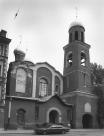
Church of St. Nicholas of Myra
CHURCH OF ST. NICHOLAS OF MYRA, located on the corner of Second Sovetskaya Street and Bakunina Avenue. It was constructed in 1913-15 in the Novgorod-Pskov style (architect S. S. Krichinsky)
|
|
|
|
|
hidden
|
Church Press
CHURCH PRESS appeared in St. Petersburg after the organisation of the first printing presses, the first of which was established at the Alexander Nevsky Monastery in 1720
|
|
|
|
|
hidden
|
Collegiums (entry)
COLLEGIUMS, central State control facilities, organised on the principle of departments; established by Tsar Peter the Great in 1717-21. Each collegium was headed by a president appointed by the Tsar; each president had a vice-president as a
|
|
|
|
|
hidden
|
Diocesan Congregation in the Name of the Mother of God
DIOCESAN CONGREGATION IN THE NAME OF THE MOTHER OF GOD was established in St. Petersburg in 1884 on the initiative of Arseny (Bryantsev), Bishop of Vyborg, with the purpose of propagating religious and moral education among the public and of
|
|
|
|
|
hidden
|
Domestic Chapel (entry)
DOMESTIC CHAPEL, churches in private houses, palaces, state, military and public institutions, academic establishments, prisons etc. The first Domestic chapels emerged in St
|
|
|
|
|
hidden
|
Feofan (Feofan Prokopovich (1681-1736), statesman and church figure, writer
FEOFAN/THEOPHAN (lay name Eleazar Prokopovich) (1681-1736, St. Petersburg), church figure. He studied at Kiev Theological Academy (until 1698), then at colleges of Vladimir-Volynsky
|
|
|
|
|
hidden
|
Gavriil (Petrov) (1730-1801), Metropolitan of Nivgorod and St. Petersburg 1770-99
GAVRIIL (lay name Petr Petrovich Petrov-Shaposhnikov) (1730-1801), Church figure, honorary member (1776) and full member (1783) of the St. Petersburg Academy of Sciences. He graduated from the Slavonic-Greek-Latin Academy in Moscow (1754)
|
|
|
|
|
hidden
|
Glubokovsky N.N. (1863-1937), theologian
GLUBOKOVSKY Nikolay Nikanorovich (1863-1937), church historian, theologian, Doctor of Theology (1897), corresponding member of St. Petersburg Academy of Sciences (1909)
|
|
|
|
|
hidden
|
Golitsyn Family
GOLITSYN, princely family, the Gediminovich Dinasty, important in the 16th century. Several members, including Prince M.M. Golitsyn, were closely associated with St. Petersburg. His son was Alexander Mikhailovich Golitsyn (1718-1783, St
|
|
|
|
|
hidden
|
Grigory (Chukov) (1870-1955), Metropolitan
GRIGORY (born Nikolay Kirillovich Chukov) (1870-1955), religious figure. After graduating from St. Petersburg Theological Academy in 1895, he took the post of the eparchial superintendent for theological schools of Olonets Eparchy
|
|
|
|
|
hidden
|
Isidor (Nikolsky) (1799-1892), Metropolitan of Novgorod and St. Petersburg 1860-1892
ISIDOR (born Iakov Sergeevich Nikolsky) (1799-1892, St. Petersburg), religious figure, honorary member of the St. Petersburg Academy of Sciences (1857). After graduating from St
|
|
|
|
|
hidden
|
Konstantin Konstantinovich, (1858-1915), Grand Prince
KONSTANTIN KONSTANTINOVICH (1858, Strelna - 1915, Pavlovsk), Grand Prince, Infantry General (1907), Adjutant General (1901), honorary member of the St. Petersburg Academy of Sciences (1900). Son of Grand Prince Konstantin Nikolaevich
|
|
|
|
|
hidden
|
Markov A.A., (1856-1922), mathematician
MARKOV Andrey Andreevich (1856-1922, Petrograd), mathematician, member of St. Petersburg Academy of Sciences (1886). Graduated from the Faculty of Physics and Mathematics of the University of St. Petersburg in 1878
|
|
|
|
|
hidden
|
Metochions (entry)
METOCHIONS of monasteries and eparchies of the Russian Orthodox Church. In 1715, by order of Tsar Peter the Great, the metochions of St. Sergius Trinity Monastery (from 1744
|
|
|
|
|
hidden
|
Muravyev A.N. (1806-1874), theological writer
MURAVYEV Andrey Nikolaevich (1806-74), spiritual writer, playwright and poet, honorary member of St. Petersburg Academy of Arts (1832), chamberlain (1836). He received a home education
|
|
|
|
|
hidden
|
Nikitin I.N., (circa 1690-1742), Artist
NIKITIN Ivan Nikitich (c. 1690-1742) artist, one of the founders of secular painting in Russia. In 1711, he was sent from Moscow to St. Petersburg as a master of the Armoury. In 1716-20, he was sent to study in Italy by order of Peter the Great
|
|
|
|
|
hidden
|
Nikodim (Rotov) (1929-1978), Metropolitan of Leningrad and Novgorod 1963-1978
NIKODIM (lay name Boris Georgievich Rotov) (1929-1978), church figure. In 1947, he took monastic vows under the name of Nikodim, and was sent to serve in the Arch-Eparchy of Yaroslavl
|
|
|
|
|
hidden
|
Pallady (Raev) (1827-1898), Metropolitan of St. Petersburg and Ladoga in 1892-1898
PALLADY (born Pavel Ivanovich Raev-Pisarev) (1827-1898, St. Petersburg), religious figure, Honorary Member of St. Petersburg Academy of Sciences (1894). After graduating from Kazan Theological Academy (1852)
|
|
|
|
|
hidden
|
Pobedonostsev K.P. (1827-1907), statesman
POBEDONOSTSEV Konstantin Petrovich (1827-1907, St. Petersburg), statesman, lawyer, writer and translator, Full Privy Councilor (1883), Personal Secretary (1894). Graduated from the Jurisprudence College in St. Petersburg in 1846
|
|
|
|
|
hidden
|
Preservation of Historical and Cultural Monuments
PRESERVATION OF HISTORICAL AND CULTURAL MONUMENTS. A systematic comprehensive organization of measures aimed at research, preservation, restoration and controlled use of inherited structures and objects of cultural importance
|
|
|
|
|
hidden
|
Printing Houses (entry)
PRINTING HOUSES. In 1711-21, four printing houses were opened in St. Petersburg by order of Tsar Peter the Great: the St. Petersburg Printing House, the Senate Printing House
|
|
|
|
|
hidden
|
Russian Historical Archive
RUSSIAN HISTORICAL ARCHIVE, STATE (RSHA) (4 Angliiskaya Embankment) was founded in 1925 as the Leningrad Historical Archive. In 1929-34, it became Leningrad Department of the Central Historical Archive
|
|
|
|
|
hidden
|
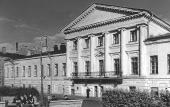
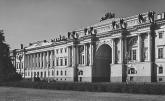
Senate and Synod Buildings
SENATE AND SYNOD BUILDINGS (1 and 3 Decabristov Square), architectural monuments of the late Neoclassical. This ground on the embankment of the Neva River was owned by A.D. Menshikov from the early 18th century, then by A.I
|
|
|
|
|
hidden
|
Serafim (Glagolevsky) (1757-1843), Metropolitan of Novgorod and St. Petersburg in 1821-1843
SERAFIM (born Stefan Vasilievich Glagolevsky) (1757-1843, St. Petersburg), religious figure, honorary member of St. Petersburg Academy of Sciences (1841). He studied at Moscow Theological Academy from 1782 and simultaneously attended lectures at
|
|
|
|
|
hidden
|
Shchedrin A.F. (1796-1847), architect
SHCHEDRIN Apollon Feodosievich (1796-1847), architect, representative of late Neoclassicism. The son of F.F. Shchedrin. In 1818, graduated from the Academy of Fine Arts
|
|
|
|
|