Bibliographies
/
Горышина Т.К. Зеленый мир старого Петербурга. СПб., 2003
hidden
|
Balashov A.D., Governor General in 1809-10
Balashov (Balashev) Alexander Dmitrievich (1770-1837, Kronstadt), statesman, Infantry General (1823), Adjunct General (1809). He was brought up in the Corps of Pages, from 1791, he was in military service
|
|
|
|
|
hidden
|
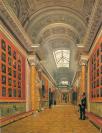
Barclay de Tolli M.B. (1757-1818), military commander, Field Marshal-General
BARCLAY DE TOLLI Mikhail Bogdanovt (Michael Andreas) (1757-1818), prince (1815), military leader and field marshal general (1814). From 1776 served with the Russian Army, took part in wars against Turkey (1787-91) and Sweden (1788-90 and 1808-09)
|
|
|
|
|
hidden
|
Bazhenov V.I., (1737-1799) architect
BAZHENOV Vasily Ivanovich (1737-1799, St. Petersburg), architect, member of the Academy of Fine Arts (1765), Member of the Russian Academy (1784), the Actual Privy Counsellor (1796). In 1756, he came to St
|
|
|
|
|
hidden
|
Borovikovsky V.L. (1757-1825), painter
BOROVIKOVSKY Vladimir Lukich (1757-1825, St. Petersburg), painter. Lived in St. Petersburg from 1788. He was a student of D. G. Levitsky and I. B. Lampi the Elder from 1792. A member of the Academy of Arts from 1795 and an advisor from 1802
|
|
|
|
|
hidden
|
Bryullov K.P. (1799-1852), artist
BRYULLOV Karl Pavlovich (1799, St. Petersburg - 1852), painter. A. P. Bryullov’s brother. He studied under A. I. Ivanov, A. E. Egorov, and V. K. Shebuev in the Academy of Arts in 1809-21
|
|
|
|
|
hidden
|
Cathedral of Prince St. Vladimir
CATHEDRAL OF PRINCE ST. VLADIMIR, (Dobrolyubova Avenue, 26 Blokhina Street), an architectural monument in a transitional style from Baroque to Classicism. The Cathedral is located on the so-called mokrushi, soggy, regularly flooded lowland
|
|
|
|
|
hidden
|
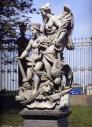
Decorative Monumental Sculpture (entry)
DECORATIVE MONUMENTAL SCULPTURE. The art of monumental sculpture dates back to the time of Peter the Great; its first examples appeared throughout St. Petersburg, at the Summer Garden and various suburb residences
|
|
|
|
|
hidden
|
Demut-Malinovsky V.I., (1779-1846), sculptor
DEMUT-MALINOVSKY Vasily Ivanovich (1779 - 1846, St. Petersburg), sculptor. Studied at the Academy of Arts (1785-1800) under M.I. Kozlovsky, and received a retainer from the Academy of Arts to study in Rome (1803-06)
|
|
|
|
|
hidden
|
Foil Rolling Plant
FOIL ROLLING PLANT (1 Perevoznaya Street), an open joint-stock company from 1992, the only aluminium foil manufacturer in European Russia. It was founded by K. N
|
|
|
|
|
hidden
|
Fountains (entry)
FOUNTAINS. The first fountains in St. Petersburg were laid out at the beginning of the 18th century in the Summer Garden. In 1717, the first engine was ordered (engineer Desaguliers) for their water supply and in 1717-1721 Ligovsky Canal was dug
|
|
|
|
|
hidden
|
Geological location
GEOLOGICAL LOCATION. St. Petersburg along with its outskirts is located on the convergence of two major tectonic structures: the southern Baltic Plate and the Northwest Russiаn Plate of the East European plain
|
|
|
|
|
hidden
|
Gonzaga P. (1751-1831), artist, decorator
GONZAGA. Gonzago Peter Fedorovich (Pietro di Gottardo) (1751-1831, St. Petersburg), theatrical designer, painter, decorator, architect, theorist, honorary free member of Academy of Arts (1794). Studied in Venice and Milan. Came to St
|
|
|
|
|
hidden
|
Gordeev F.G., (1744-1810), sculptor
Gordeev Fedor Gordeevich (1744, Tsarskoe Selo - 1810, St. Petersburg), sculptor. Studied at the Academy of Arts (1759-67) under N.F. Gillet, and received a retainer from the Academy of Arts to study in Paris (1767 - 1769) and in Rome (1769 - 1772)
|
|
|
|
|
hidden
|
Grigory (Chukov) (1870-1955), Metropolitan
GRIGORY (born Nikolay Kirillovich Chukov) (1870-1955), religious figure. After graduating from St. Petersburg Theological Academy in 1895, he took the post of the eparchial superintendent for theological schools of Olonets Eparchy
|
|
|
|
|
hidden
|
Grilles (entry)
GRILLES. St. Petersburg boasts a number of unique metal grilles, created in the course of three centuries. Wrought grilles of bars with (sometimes gilded) decorative figures made from flat iron bars (the grille of the Ekaterininsky (Catherine)
|
|
|
|
|
hidden
|
Kazanskaya Square
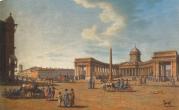
AZANSKAYA SQUARE, located at the intersection of Nevsky Prospect and Griboedova Canal. Known as Plekhanova Square from 1923 to 1944. The square appeared in the early 19th century
|
|
|
|
|
hidden
|
Kazanskaya Street
KAZANSKAYA STREET known as First Perevedenskaya Street in the 1740s, Bolshaya Meshchanskaya Street from the 1750s to 1873, and Plekhanova Street in memory of G. V. Plekhanov from 1923 to 1998. The street runs between Nevsky Prospect and Fonarny Lane
|
|
|
|
|
hidden
|
Kazansky Bridge
KAZANSKY BRIDGE (in 1766-1830 Rozhdestvensky Bridge, in 1923-44 Plekhanova Bridge), over Griboedova Canal, on Nevsky Prospect by Kazan Cathedral (hence the name). It was built in 1765-66 (engineer V. I. Nazimov, I. М
|
|
|
|
|
hidden
|
Kazansky Demonstrations
KAZANSKY DEMONSTRATIONS, mass political gatherings on the square in front of Kazan Cathedral on 6 December 1876. The first political demonstration in Russia was held here, organized by the secret society Land and Liberty (Zemlya i Volya)
|
|
|
|
|
hidden
|
Kazansky Island
KAZANSKY ISLAND, an area in the centre of St. Petersburg between the Moika River, Griboedova Canal, and Kryukov Canal. The area is over 120 hectares. It was a part of Pervushin Island that also included Kolomensky Island, Pokrovsky Island
|
|
|
|
|
hidden
|
Kutuzov M.I. (1745-1813), military commander, Field Marshal-General
KUTUZOV (Golenishchev-Kutuzov) Mikhail Illarionovich (1745-1813), Gracious Prince Smolensky (1812), commander, Field-Marshal General (1812). He graduated from Artillery school and Engineering school in St. Petersburg (1759)
|
|
|
|
|
hidden
|
Lvov N.A. (1751-1803), architect
LVOV Nikolay Alexandrovich (1751-1803), architect, poet, engraver, scientist, engineer, privy counsellor, member of the Russian Academy (1783), honorary member of the Academy of Arts (1786). Received a home education
|
|
|
|
|
hidden
|
Martos I.P., (1754-1835), sculptor
MARTOS Ivan Petrovich (1754-1835, St. Petersburg), sculptor, follower of Classicism. Studied at the Academy of Arts (1764-73) under L. Rolland and N.F. Gillet, and received a retainer from the Academy of Arts to study in Italy (1774-1790
|
|
|
|
|
hidden
|
Miracle-Working and Revered Icons (entry)
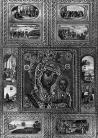
MIRACLE-WORKING AND REVERED ICONS. The most famous Miracle-Working icon of Our Lady of Kazan — the copy of the 16th century of the lost Miracle-Working icon of the same name, can now be seen in the Kazan Cathedral
|
|
|
|
|
hidden
|
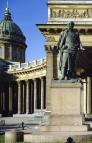
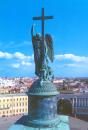
Monuments to the War of 1812-1814
MONUMENTS TO THE WAR OF 1812-1814, memorial constructions in honour of Russia's military victories during the Patriotic War of 1812 and the campaigns of 1813-14 against Emperor Napoleon I concluding with allied troops marching into Paris on 19 March
|
|
|
|
|
hidden
|
Museum of History of Religion
MUSEUM OF HISTORY OF RELIGION (14/5 Pochtamtskaya Street) is the only institution of such kind in the country. The museum dates back to the antireligious exhibition arranged in the halls of the Winter Palace in 1930
|
|
|
|
|
hidden
|
Natural stone
NATURAL STONE. Since the early 18th century, Putilovo slab limestone has been used in construction (quarried by Putilovskaya Mountain near the mouth of the Volkhov River)
|
|
|
|
|
hidden
|
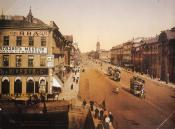
Nevsky Prospect
NEVSKY PROSPECT known as Bolshaya Pershpektivnaya Road or Bolshaya Pershpektiva until 1738, Nevskaya Prospektivaya Street or Nevskaya Perspektiva in 1738-1780s, and 25 October Avenue in 1918-44 so named in memory of the October Revolution of 1917
|
|
|
|
|
hidden
|
New Martyrs (entry)
NEW MARTYRS, representatives of the Orthodox clergy and laity, who died for their faith after the revolution. The title of the Protomartyr of St. Petersburg Eparchy was given to Archpriest Ioann Kochurov, Prior of St
|
|
|
|
|
hidden
|
Orlovsky B.I., (1796-1837), sculptor
ORLOVSKY (real name Smirnov) Boris Ivanovich (1796-1837), sculptor, adherent of Classicism. Born into a family of serfs. From 1809 studied in Moscow under S.P. Campioni, and from 1817 in St. Petersburg under A. Triscorni
|
|
|
|
|