hidden
|
Baltic Shipping Company
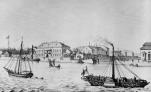
BALTIC SHIPPING COMPANY (BSC). The history of BSC (5 Mezhevoy Canal) goes back to the foundation of St. Petersburg-Lubeck Shipping Society in 1830; its present-day name was given in 1922. By 1941 BSC had 20 ships
|
|
|
|
|
hidden
|
Baltic Shipyard and Machine-Building Plant
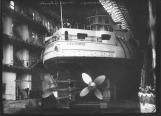
BALTIC SHIPYARD AND MACHINE-BUILDING PLANT (16 Kosaya Line), open joint-stock company, one of the biggest ship and machine building enterprises of Russia. It was founded in 1856 by M. E. Karr, a merchant and M. L. McPherson, an engineer
|
|
|
|
|
hidden
|
Baltiiskaya Pipeline System
BALTIISKAYA PIPELINE SYSTEM. A network of pipelines in the Northwestern Federal District of Russia, intended to transport petroleum and crude oil from the Komi Republic and Western Siberia for export and to meet the region's needs
|
|
|
|
|
hidden
|
Baltiysky Railway Station
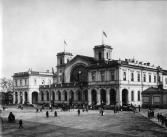
BALTIYSKY RAILWAY STATION (120 Obvodny Canal Embankment). The station was built in 1853 after a railway between St. Petersburg and Peterhof was completed, and was originally called Peterhofsky Railway Station. Architect A.I
|
|
|
|
|
hidden
|
Balyberdin V.S., (1949-1994), mountaineer
BALYBERDIN VLADIMIR SERGEEVICH (1949-1994), mountaineer, Merited Master of Sports of the USSR (1982). He was the first Russian mountaineer to climb Mount Everest (3-9.5.1982), a К-2 peak (Pakistan)
|
|
|
|
|
hidden
|
Bank Buildings (entry)
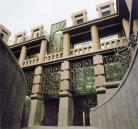
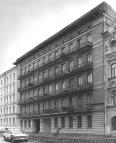
BANK BUILDINGS, public buildings designed for housing finance and credit institutions. The first special bank buildings were the Assignation Bank building at Sadovaya Street (1783-90, architect G
|
|
|
|
|
hidden
|
Bankovsky Bridge
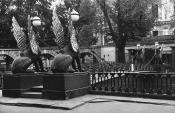
BANKOVSKY BRIDGE, spanning Griboedov Canal, by the building of the former Assignation Bank (hence the name). Built in 1825-26 (engineer V.K. Tretter) as a chain footbridge with four cast iron griffin figures (sculptor P.P. Sokolov)
|
|
|
|
|
hidden
|
Banks (entry)
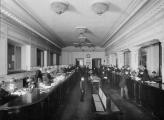
BANKS, credit system institutions. St. Petersburg has been the central element of the system from the time it came into being through 1917. The first banks in Russia were founded on the initiative of the state and financed from the treasury
|
|
|
|
|
hidden
|
Barannikov A.P. (1890-1952), philologist, Member of the Academy of Sciences of the USSR
BARANNIKOV Alexey Petrovich (1890-1952, Leningrad), scholar of Eastern Studies, Indianist, member of the Academy of Sciences of the USSR (1939). Graduated from the Faculty of History and Philology of Kiev University in 1914
|
|
|
|
|
hidden
|
Baranov N.M., Chief of City Administration 1881
BARANOV Nikolay Mikhailovich (1837-1901), statesman, Lieutenant General (1893). Baranov graduated from the Naval Cadet Corps in St. Petersburg (1856). From 1856, he served in the Navy, in 1866-77, he headed the Naval Museum
|
|
|
|
|
hidden
|
Baranov N.V. (1909-1989), architect
BARANOV Nikolay Varfolomeevich (1909-1989), architect, National architect of the USSR (1972), the full member of the Academy of Fine Arts of the USSR (1979). He graduated from the College of Hydraulic Engineers (1931) and from the Academy of Fine
|
|
|
|
|
hidden
|
Baranovsky G.V.(1860-1920), architect
BARANOVSKY Gavriil Vasilievich (1860-1920, St. Petersburg), architect, architecture historian, editor. Upon graduation from the College of Civil Engineers (1885), in 1885-1917
|
|
|
|
|
hidden
|
Baranovsky V. S. (1846-1879), entrepreneur
BARANOVSKY Vladimir Stepanovich (1846-1879, St. Petersburg), inventor, designer, and entrepreneur. Educated at home, he attended lectures in one of institutes in Paris and studied on and off at St. Petersburg University
|
|
|
|
|
hidden
|
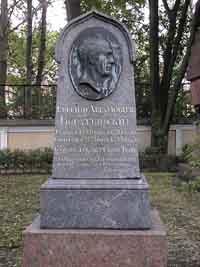
Baratynsky E.A. (1800-1844), poet
BARATYNSKY Evgeny Abramovich (1800-1844), poet. In 1812-16 he was educated in the Page Corps. In 1816 he was expelled for misbehaviour (a theft) without the right to serve and went to Smolenskaya Province. In 1818 he returned to St
|
|
|
|
|
hidden
|
Barclay de Tolli M.B. (1757-1818), military commander, Field Marshal-General
BARCLAY DE TOLLI Mikhail Bogdanovt (Michael Andreas) (1757-1818), prince (1815), military leader and field marshal general (1814). From 1776 served with the Russian Army, took part in wars against Turkey (1787-91) and Sweden (1788-90 and 1808-09)
|
|
|
|
|
hidden
|
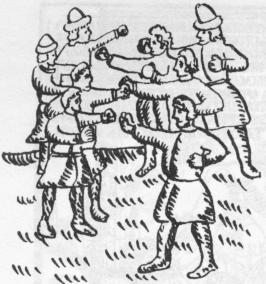
Bare-knuckle Boxing
BARE-KNUCKLE BOXING, an old Russian popular amusement, grew out of combat technique practised by Old Russian unmounted warriors. Bare-knuckle boxing took place on holidays only, and usually several people took part in it
|
|
|
|
|
hidden
|
Barkov I.S. (1732-1768), poet
BARKOV Ivan Semenovich (1732, St. Petersburg [?] - 1768) poet, historian, translator. He studied at the Alexander Nevsky Theological Seminary from 1744; in 1748 he was accepted into the Academic Institute
|
|
|
|
|
hidden
|
Barmaleeva Street
BARMALEEVA STREET situated in Petrogradskaya part between Bolshaya Pushkarskaya Street and Chkalovsky Avenue. It was laid in the settlement of St. Petersburg Regiment in 1730s and named after landowner Major Stepan Barmaleev in the late 18th century
|
|
|
|
|
hidden
|
Baroque
BAROQUE, an artistic style. Its forms are closely related to the art of late antiquity and Renaissance (it applies to order elements, elaborately combined with such ornamental motifs as draped atlantes' torsos or leaves of acanthus)
|
|
|
|
|
hidden
|
Barracks of the Fourth Life Guard Rifle Imperial Family Regiment
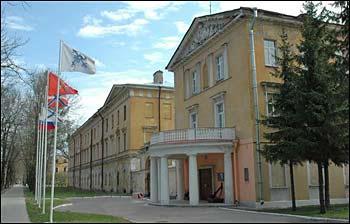
The barracks occupies the whole area opposite the Catherine Park and the Admiralty on Parkovaya Street and limited by Kadetsky Boulevard, Krasnoy Zvezdi (Red Star) Street and Ogorodnaya Street
|
|
|
Source: Tsarskoe Selo
|
|
hidden
|
Barracks of the Own His Emperor Majesty Escort
During its random staying in Tsarskoye Selo over the 19th century the Emperor Escort occupied hussar and cuirassier barracks. The first permanent wooden barracks of the Own His Emperor Majesty Escort were built in 1895 in the Alexander Park in
|
|
|
Source: Tsarskoe Selo
|
|
hidden
|
Barracks of the Second Life Guard Rifle Regiment with the Church of the Saint Sergy of Radonezh
In 1871 the buildings of the Sophia Provision Shops, built in 1821-1822 to the design of the architect V.P. Stasov, were rebuilt for permanent apartments of the Tsarskoye Selo riflemen
|
|
|
Source: Tsarskoe Selo
|
|
hidden
|
Barracks of the Third Life Guard Rifle His Emperor Majesty Regiment
The architectural ensemble of barracks of the Third Life Guard His Emperor Majesty Regiment was built in 1914-1916 to the design of the architect V.A. Pokrovsky
|
|
|
Source: Tsarskoe Selo
|
|
hidden
|
Bartold V.V., (1869-1930), orientalist
BARTOLD Vasily Vladimirovich (1869, St. Petersburg - 1930, Leningrad), orientalist, Member of the Petersburg Academy of Sciences (1913). Graduated from the Oriental Languages Faculty of Petersburg University in 1891
|
|
|
|
|
hidden
|
Barutchev A.K., (1904-1976), architect
BARUTCHEV Armen Konstantinovich (1904 - 1976, Leningrad), architect, graphic artist, teacher, Honorary architect of the Russian Soviet Federation of Soviet Republics, graduated from the Academy of Fine Arts (1927)
|
|
|
|
|
hidden
|
Basin House
BASIN HOUSE (5 Ostrovsky Square), architectural monument of the Neo-Byzantine style, apartment house of N.P. Basin (built by his plans in 1878-79). The house facades with windows of varied patterns and featuring so-called “polotentsa” (towels)
|
|
|
|
|
hidden
|
Baskov Lane
BASKOV LANE between Korolenko Street and Fontannaya Street. The street was named after landowner and merchant Baskov in 1800s. The street was laid in the mid-18th century up to the present-day Radishcheva Street and extended up to Fontannaya Street
|
|
|
|
|
hidden
|
Basseinaya Street
BASSEINAYA STREET, translated as Pool Street, between Kubinskaya Street and Vitebsky Avenue. The name originated from a canal (pool) that was then in design. The street is roughly in line with the former Azovskaya Street, Erivanskaya Street
|
|
|
|
|
hidden
|
Baths (entry)
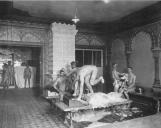
BATHS. The first baths in St. Petersburg were built near rivers and other reservoirs, separate from residential houses. About 30 so-called commercial baths were constructed by 1720. Construction was paid for by the Treasury
|
|
|
|
|
hidden
|
Battistini М.(1856-1928), singer
BATTISTINI Mattia (1856-1928), Italian singer, baritone. With a soft expressive voice and a well-developed upper register, he was a darling of the audience. His career began in 1878 in Rome. Battistini's repertoire included roles in operas by G
|
|
|
|
|