|
|
Entries
/
Tauride Palace
Tauride Palace
Categories /
Architecture/Architectural Monuments/Palaces
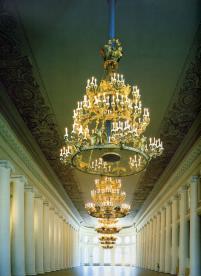
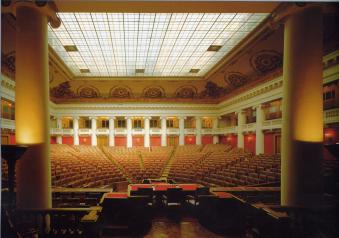
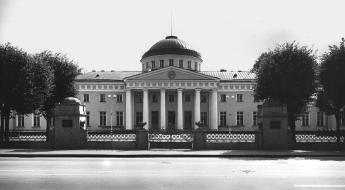
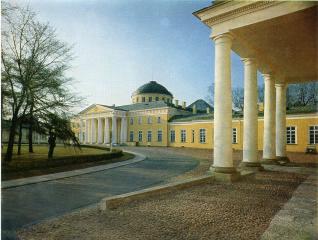
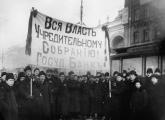
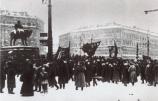
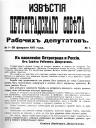
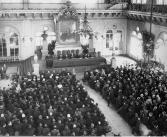
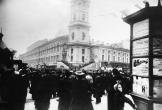
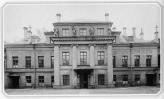
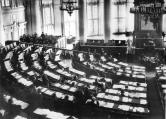
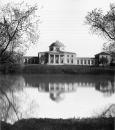
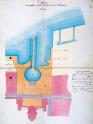
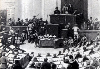
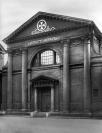
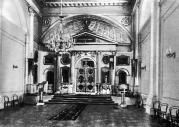
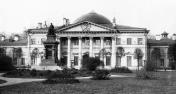
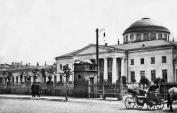
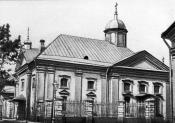
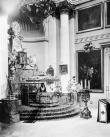
TAURIDE PALACE (47 Shpalernaya Street), an architectural monument of Neoclassical. It was constructed in 1783-1789 (architect I.E. Starov) for Prince G.A. Potemkin-Tavrichesky (hence the name). The central two-storey building with a low cupola on a low drum is adorned with a six-columned Doric portico with a three-cornered pediment. Galleries connect the main building with the second-storey wings that are decorated with a four-column portico. Modest facades of the Tauride Palace harmonized with its splendid interiors: behind the main entrance hall, there was a domed hall, opening on the grand columns gallery (74.5 metres long), behind which a winter garden was located. The gala premises (the Picture Hall, the Tapestry Sitting Room, the Sofa Room, the Chinese Hall and others) have partly retained the original artistic decor (polychrome wall-paintings, figured stoves). On 28 April 1791, in the Tauride Palace a holiday described by G.R. Derzhavin was held. After the death of its owner, the Tauride Palace was brought into the possession of the treasury and rebuilt in 1792-1793 (architect F.I. Volkov) as a summer residence for Empress Catherine II. In the eastern wing a theatre hall was arranged, in the western wing - a church. From the Neva to the Tauride Palace, a canal with a ladle-shaped harbour was dug (in 1858-1863 on their site a Central city waterworks were constructed; architects I.A. Merz, E.G. Shubensky). In 1799, Emperor Pavel I commissioned the Tauride Palace to be adjusted to become the barracks of Cavalry Life Guards Regiment. In 1802-03, the Tauride Palace was restored (architect L.I. Rusca) as an Imperial palace. Later architects K.I. Rossi and V.P. Stasov worked on its finishing. In the 19th century in the Tauride Palace members of Imperial family, Russian state figures and foreign guests lived; celebrations, balls and exhibitions were arranged regularly. In 1906-17, the State Duma met on the premises of the Tauride Palace (interiors were refashioned in 1906-10, architects A.R. Bach, P.I. Shestov, engineer N.V. Smirnov). After the February revolution of 1917 the Provisional Government and Petrograd Soviet of Workers' Deputies stayed for a certain period of time in the Tauride Palace; here on 5(18) January 1918 the Constituent Assembly was opened. In 1920-91 the Tauride Palace was used for the High Party School. Since 1992 it has housed the Inter-Parliamentary Assembly of the countries of Commonwealth of Independent States. The architectural complex of the Tauride Palace also encompasses a manor house of garden master W. Guld (1792-94, architect F.I. Volkov). From the name Tauride Palace the names of Tavrichesky Garden, Tavricheskaya Street and Tavrichesky Lane originate. References: Дьяченко Л. И., Кротов М. И. Таврический дворец: (Прошлое и настоящее). СПб., 2002; Шуйский В. К. Таврический дворец. СПб., 2003. S. V. Boglachev.
Persons
Bach Alexander Romanovich
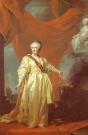
Catherine II, Empress
Derzhavin Gavriil Romanovich
Guld William
Paul (Pavel) I, Emperor
Potemkin Grigory Alexandrovich, Gracious Prince of Tauride
Rossi Carl Ivanovich (Carlo Giovanni)
Rusca Luigi (Aloisy Ivanovich)
Shestov Peter Ivanovich
Shubersky (Shubergsky) Ernest Gustavovich
Smirnov Nikolay Vasilievich
Starov Ivan Egorovich
Stasov Vasily Petrovich
Volkov Fedor Ivanovich
Volkov Fedor Ivanovich
Addresses
Shpalernaya St./Saint Petersburg, city, house 47
Bibliographies
Дьяченко Л. И. Таврический дворец. СПб., 1997
The subject Index
Provisional Government of 1917
Constituent Assembly, All-Russian
Chronograph
1783
1791
1905
1920
1992
hidden
|
Brenna V.F. (1745-1819), architect
BRENNA Vikenty Franzevich (1745-1819 or 1820?), architect, decorative artist, a representative of Neoclassicism. Native of Italy. Prior to his coming to Russia, he worked in Rome and Warsaw
|
|
|
|
|
hidden
|
Catherine II (1729-1796), Empress
Catherine II (1729-1796, St. Petersburg), Empress (from 1761), wife of Emperor Peter III (1745). Nee Sophie Augusta Frederica of Anhalt-Zerbst. Lived in St. Petersburg from 1744, coming to power by dethroning her husband (1762)
|
|
|
|
|
hidden
|
Central Duma
CENTRAL DUMA (Central City Duma) is the elected organ of city self-government. It was set up by the Provisional Government after the February revolution of 1917, dealing with the same problems as the previous City Duma
|
|
|
|
|
hidden
|
City Administration (entry)
CITY ADMINISTRATION. The system of City Administration in St. Petersburg from the beginning of the 18th century developed in 2 directions - the city government and self-government (see City self-government). From 1703 the city was governed by A. D
|
|
|
|
|
hidden
|
Constituent Assembly, All-Russian
ALL-RUSSIAN CONSTITUENT ASSEMBLY, a body of representatives established on the basis of universal suffrage in order to form a government and draft a Constitution for Russia
|
|
|
|
|
hidden
|
Dyagilev S.P., (1872-1929), worker of theatre and arts
DYAGILEV Sergey Pavlovich (1872-1929), theatrical and artistic figure, publisher and critic. He lived in St. Petersbrug from 1890. Graduated from Petersburg University with a major in law in 1896
|
|
|
|
|
hidden
|
Factories and Plants' Committees
FACTORIES AND PLANTS' COMMITTEES, elected bodies of workers and employees' for self management. Emerged after the February Revolution of 1917, in contrast to trade unions
|
|
|
|
|
hidden
|
February Revolution of 1917
FEBRUARY REVOLUTION OF 1917 is the Second Russian Revolution, which dethroned the Monarchy. Decisive events developed in Petrograd. On 23 February (8 March) 1917
|
|
|
|
|
hidden
|
First All-Russian Congress of Soviets of Workers' and Soldiers' Deputies
FIRST ALL-RUSSIAN CONGRESS OF SOVIETS OF WORKERS' AND SOLDIERS' DEPUTIES. Held on 3-24 June (16 June - 7 July) 1917. Most of the sittings were held in the 1st Cadet Corps building (3/1 Kadetskaya Line); some were held at Tauride Palace
|
|
|
|
|
hidden
|
Funeral Rites (entry)
FUNERAL RITES. Burials during the building of St. Petersburg were noted for their utmost simplicity. As C. Weber (1718) witnessed, "a body wrapped in a coarse bast sack, tightened with ropes, and put on a bier
|
|
|
|
|
hidden
|
Grilles (entry)
GRILLES. St. Petersburg boasts a number of unique metal grilles, created in the course of three centuries. Wrought grilles of bars with (sometimes gilded) decorative figures made from flat iron bars (the grille of the Ekaterininsky (Catherine)
|
|
|
|
|
hidden
|
Industrial Exhibitions (entry)
INDUSTRIAL EXHIBITIONS, organised by the government from the 1820s, intended to boost the national industry, interior and foreign trade, under the jurisdiction of the Trade and Manufactory Department of the Ministry of Finance
|
|
|
|
|
hidden
|
Kozlovsky M.I., (1753-1802), sculptor
KOZLOVSKY Mikhail Ivanovich (1753 - 1802, St. Petersburg), sculptor, representative of Classicism. Studied at the Academy of Arts from 1764 until 1773 under N.F. Gillet and A.P. Losenko, and became a member in 1794
|
|
|
|
|
hidden
|
Leningrad Soviet
LENINGRAD SOVIET (Leningrad City Soviet of People"s Deputies), the supreme authority on the terriory of Leningrad. It originated from Petrograd Soviet of working people and soldiers" deputies founded on February 27 (March 12 New Style)
|
|
|
|
|
hidden
|
Manors and Dachas (entry)
MANORS AND DACHAS. Within the precincts of modern St. Petersburg a number of the 18th -19th centuries manors and dachas (summer residences) have been preserved, also there are some fragments of manors on Petergofskaya (Peterhof) road
|
|
|
|
|
hidden
|
Patersen Benjamin, (1750-1810), Artist
PATERSEN Benjamin (1750-1810, St. Petersburg) Swedish artist, water colour painter and engraver. He received his artistic education in Goteborg. He lived in St. Petersburg from 1786
|
|
|
|
|
hidden
|
Pavsky G.P. (1787-1863), Archpriest
PAVSKY Gerasim Petrovich (1787, Churchyard of Pava of St. Petersburg province - 1863, St. Petersburg), archpriest, philologist and church historian, Doctor of Theology (1821), member of St. Petersburg Academy of Sciences (1858)
|
|
|
|
|
hidden
|
Petrograd Soviet of working people' and soldiers' deputies
PETROGRAD SOVIET OF WORKING PEOPLE' AND SOLDIERS' DEPUTIES (Petrograd Soviet), was established on February 27 (March 12 New Style), 1917 as Petrograd Soviet of working people's deputies; on March 1 (14 New Style) it united with Petrograd Soviet of
|
|
|
|
|
hidden
|
Political Parties (entry)
POLITICAL PARTIES, groups of people united by political opinions and goals fixed in party documents; possessing certain membership requirements, internal structure and types of activities stated in the regulations; relying on a certain social base
|
|
|
|
|
hidden
|
Potemkin G. A. (1739-1791), statesman
POTEMKIN (from 1775 Potemkin-Tavrichesky) Grigory Alexandrovich (1739-1791), Count (1774) and His Highness, Prince (1775), statesman and military officer, favourite of Empress Catherine II, her secret spouse (from 1774) and virtual co-ruler
|
|
|
|
|
hidden
|
Provisional Government of 1917
PROVISIONAL GOVERNMENT was the highest state organ of power in Russia, from 2 (15) March until 25 October (7 November) 1917. It was formed after the February Revolution of 1917 by the Provisional Committee of the State Duma in accordance with
|
|
|
|
|
hidden
|
Revolution of 1905-07
REVOLUTION OF 1905-07. The first people's bourgeois-democratic revolution in Russia. Caused by socioeconomic contradictions and the country's political development following the reforms of 1860s-70s
|
|
|
|
|
hidden
|
Rusca L.I. (1762-1822), architect
RUSCA Luigi (Aloizy Ivanovich) (1762-1822), architect, representative of late Neoclassicism. Court architect (1802), honorary associate of the Academy of Arts (1815). Of Swiss origin, he studied in Italy. In 1783, he came to St
|
|
|
|
|
hidden
|
Scotti D.B., (1776 -1830), artist
SCOTTI Giovanni Batista (Ivan Karlovich) (1776-1830, St. Petersburg), master of monumental decorative Classical painting. Studied under his father, Karl Scotti, a native of northern Italy, with whom he worked from 1786 until the 19th century
|
|
|
|
|
hidden
|
Shpalernaya Street
SHPALERNAYA STREET, from Gagarinskaya Street to Rastrelli Square. The street was known as First Line until 1727, then was called First Beregovaya Street. In the late 18th century it assumed the name Voskresenskaya Street or Voskresenskaya Embankment
|
|
|
|
|
hidden
|
Shubin F. I. (1740-1805), sculptor
SHUBIN (Shubnoy till 1761) Fedot Ivanovich (1740-1805, St. Petersburg), a sculptor. He lived in St. Petersburg from 1759. He was a student in the Academy of Arts in 1761-67, a retainer thereof in Paris in 1767-70 and Rome in 1770-72
|
|
|
|
|
hidden
|
Starov I.E. (1744-1808), architect
STAROV Ivan Egorovich (1745-1808, St. Petersburg), architect, city-planner, one of the founders of Russian Neoclassicism. Resided in St. Petersburg from 1758. Graduated from the Academy of Fine Arts (1762). Apprenticed with architect C
|
|
|
|
|
hidden
|
State Duma
STATE DUMA (1905-17), the lower house of the Russian Parliament. It was established on 6 August 1905 as a deliberating representative body for preliminary discussions of legislative proposals
|
|
|
|
|
hidden
|
Suvorov A.V.(1729-1800), military commander
SUVOROV Alexander Vasilyevich (1729-1800, St. Petersburg), military leader, Count of Rymnik (1789), Prince of Italy (1799), Generalissimo (1799). Received home education
|
|
|
|
|
hidden
|
Tavricheskaya Street
TAVRICHESKAYA STREET, called Sadovaya Street from the 1820s to 1859, and known as Slutskogo Street from 1918 to 1944, from Suvorovsky Avenue to Shpalernaya Street. The street was laid in the mid-18th century
|
|
|
|
|
hidden
|
Tavrichesky Garden
TAVRICHESKY GARDEN is a landscape architectural monument located between Shpalernaya Street, Tavricheskaya Street, Kirochnaya Street and Potemkinskaya Street. The total area consists of 21.1 hectares
|
|
|
|
|
hidden
|
The Saint Sophia Cathedral
The cathedral was built in commemoration of our victories in the Russo-Turkish wars.
The foundation stone of the cathedral was laid in the presence of Catherine II on July 30, 1782. The consecration took place on May 20, 1788
|
|
|
|
|
hidden
|
Tsentralny (Central) District
TSENTRALNY (CENTRAL) DISTRICT, an administrative-territorial entity within St. Petersburg, with the territorial administration situated at 176 Nevsky Prospect. The district was set up in 1994, when Smolninsky District
|
|
|
|
|
hidden
|
Uritsky M.S. (1873-1918), revolutionary, statesman
URITSKY Moisey Solomonovich (1873-1918, Petrograd), statesman. He graduated from the faculty of law of Kiev University (1897). After the split of Russian Social-Democratic Workers' Party (1903) he joined Mensheviks
|
|
|
|
|
|
hidden
|
|
hidden
|
|
hidden
|
|
hidden
|
|
hidden
|
|
hidden
|
|
hidden
|
|
hidden
|
|
hidden
|
|
hidden
|
|
hidden
|
|
hidden
|
|
hidden
|
|
hidden
|
|
hidden
|
|
hidden
|
|
hidden
|
|
hidden
|
|